Marvel Rivals Map Lock Hero Challenge
Video: The MAP Decides Our Heroes in Marvel Rivals
You can order the same kind of articles for your own video to boost it on YouTube and Google. Just message the Telegram bot @sat_sit_bot. It writes articles around your video, embeds the video and publishes them on popular niche websites (no ads). Your first 50 articles are free.
· based on the channel Salty Phish
Marvel Rivals is a 6v6 hero shooter where the map you queue into can dictate your hero pool just as much as the enemy composition does. A map-lock challenge turns that into a rule: whatever map loads, only heroes with a lore or visual tie to that location are legal picks. Streamer Salty Phish built a full video around this format, rolling a new hero comp every quickplay match based purely on the map, and you can watch the same live format on Salty Phish's Twitch channel.
How the Marvel Rivals map-lock challenge works
The core rule is simple: the random map decides the roster, not the player. Before the match starts, the group checks which location the queue produced, then agrees on a legal hero list for that map and locks it in. No counter-swapping to a comfort pick, no flexing to a meta hero because the enemy team went triple support.
In practice the format runs on three steps:
- Queue quickplay so the map is random and nobody can veto a bad roll.
- Read the map name and decide the allowed heroes from Marvel lore and in-game details.
- Play the match with that locked pool, even if the enemy team counters it hard.
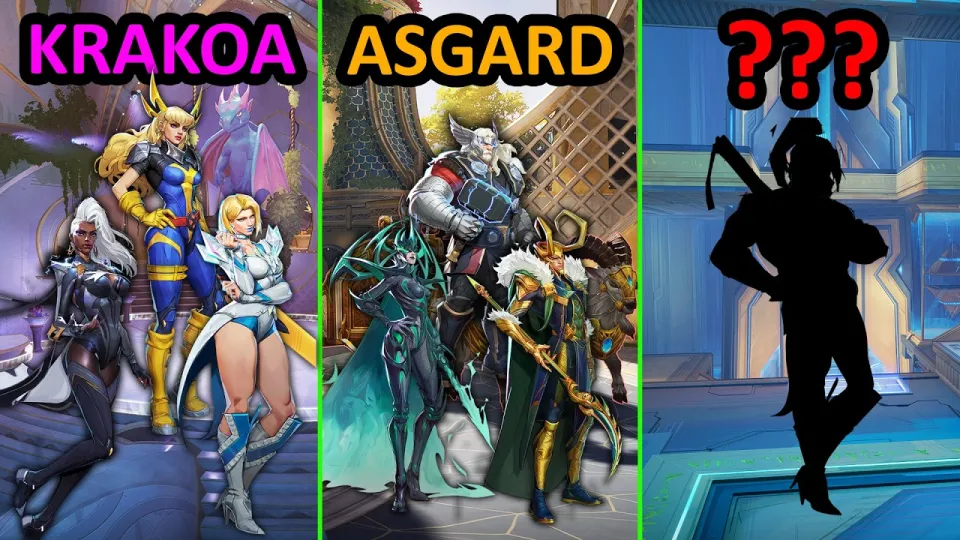
The example set used in the video is straightforward: a Klyntar map means symbiote territory, so Venom is the anchor pick; an Asgardian map opens Thor, Loki, Hela and other Asgard-linked characters. The fun comes from the grey areas, because Marvel Rivals maps are dense with references and almost every location has a defensible second or third pick.
Which heroes fit each Marvel Rivals map
The map-to-hero mapping is where the challenge becomes a lore quiz, and the obvious answers are rarely the complete list.
- Klyntar: Venom is the natural pick, and the symbiote homeworld also justifies stretching to characters who fought Knull's forces in Rivals lore.
- Asgard: Thor, Loki and Hela are the clean picks, with Asgardian-adjacent characters as the debate tier.
- Wakanda Spaceport: Black Panther is the default, but the map is an intergalactic Wakandan hub, so spacefaring heroes have a case.
- Shin-Shibuya: Psylocke and other Tokyo-linked heroes fit, and the Stark-Fujikawa building on the map pulls Iron Man into the conversation.
- Spider-Islands: a 2099 setting, which opens Miguel O'Hara-adjacent logic and pulls in characters active in that timeline.
- Midtown and Lower Manhattan: New York maps, the broadest pool in the game, where almost any street-level hero can be argued in.
The interesting part is that Marvel Rivals writes its own canon rather than borrowing the films wholesale, so comic history and in-game dialogue both count as evidence.
Marvel Rivals lore arguments that decide close calls
Marvel Rivals lore is the tiebreaker for every disputed pick, and the game has produced several details that change the map lists.
Iron Man belongs on Shin-Shibuya because the map contains the Stark-Fujikawa building, a future incarnation of a Stark subsidiary, and the game includes dialogue referencing it. The Collector's museum backstory also places Jeff the Land Shark, Psylocke and Mantis in a shared imprisonment, which links them to museum-adjacent locations rather than only to their home regions.
Wakanda's reach in Marvel Rivals is bigger than the throne room. In Rivals continuity the Wakandans built Bucky Barnes' prosthetic arm, and an in-game exchange has Tony Stark offering an upgrade that Bucky dismisses in favor of what Wakanda and Steve Rogers provided. That single line makes the Winter Soldier a defensible pick on Wakandan maps. The Wakanda Spaceport is framed as an intergalactic empire's launch point, and the Milano can be seen departing it in map animations, with the Guardians of the Galaxy sent from Wakanda to Klyntar on a mission tied to Knull's attempt to take control of Bast.
New York maps have their own outlier: Devil Dinosaur lives in New York City with Moon Girl, so a giant red dinosaur running around Manhattan is canon and counts for Lower Manhattan. Spider-Islands, set in 2099, opens the door to Punisher and Captain America as much as to Psylocke, since all three operate in that era of Marvel continuity.
Why the format works as a Marvel Rivals challenge
A map-lock rule fixes the biggest complaint about hero shooters: the endless counter-swap carousel. When the roster is fixed before the first fight, team composition becomes a puzzle solved in the spawn room instead of a reactive swap war.
It also forces time on heroes players normally skip, which is useful practice for ranked flexibility. The downside is real, though: some maps produce pools that are simply weaker into a coordinated enemy team, and quickplay is the only sane place to run it. The format is casual by design, which is why the video stays in quickplay rather than competitive, and why the Season 9 context, The Mystery of Thebes, matters mostly for the new skins and battle pass content on display.
The challenge also scales well for groups. A duo can run it with a shared list, a full stack can assign one lore researcher per match, and solo players can apply a personal version by picking only heroes tied to the loaded map.
Common questions about map-based hero rules in Marvel Rivals
Most pushback on the challenge comes from people who know the lore better than the rule set, and the disputes usually fall into four buckets.
- Is the map list fixed or improvised? Groups that run the challenge repeatedly build a slide or document with a legal pool for every map, which removes mid-match arguments.
- Do skins count as evidence? Wakanda-linked skins on heroes like Mantis, Hawkeye and Captain America are treated as valid justification by some groups, since those cosmetics tie into the same storyline.
- How strict is strict? A pedantic run allows any hero with a single in-map reference, a wanted poster or a named building; a loose run sticks to the headline pick.
- Does it work in ranked? Almost never recommended, because the locked pool cannot respond to a hard counter and the format is built for casual play.
The most common correction is simple misidentification: Shin-Shibuya and Spider-Islands are different maps with different eras and different hero pools, and mixing them up scrambles the whole list.
Salty Phish links and where to follow the challenge
All official channels for the creator behind the map-lock format are collected here:
- Twitch, for live Marvel Rivals streams: http://www.twitch.tv/saltyphish/
- Twitter: https://twitter.com/SaltyPhish
- TikTok: https://www.tiktok.com/@saltyphish
- Reddit: https://reddit.app.link/r_SaltyPhish
- Instagram: https://www.instagram.com/saltyphish/
The video also features other creators worth following for Marvel Rivals content: Foggyslips on YouTube, Grupic and Twobold on Twitch, and MoFNO on YouTube.
Marvel Rivals map-lock challenge verdict
A map-lock run is the cheapest way to make Marvel Rivals quickplay feel like a puzzle again, because it replaces meta chasing with lore knowledge and commitment. The rule set takes one sentence to explain, scales from solo play to a full stack, and every match produces an argument worth having about who actually belongs on Klyntar, Wakanda or the streets of Manhattan. The format also rewards players who read the maps instead of only the tier lists, since details like the Stark-Fujikawa building or the Milano leaving the Wakanda Spaceport are the real evidence. Salty Phish's breakdown is the reference point for the challenge, and the live version runs on Twitch if you want to see the next roll happen in real time.
Key takeaways
- The challenge rule: the randomly queued map decides which heroes a player may pick, with no free swaps.
- Klyntar locks the roster to symbiote-linked heroes such as Venom; Asgard maps open Thor, Loki and Hela.
- The Marvel Rivals map pool includes Klyntar, Wakanda Spaceport, Shin-Shibuya, Spider-Islands, Midtown and Lower Manhattan.
- Lore disputes dominate the format: Stark-Fujikawa on Shin-Shibuya, Bucky's Wakandan arm and Devil Dinosaur in New York all count as edge cases.
- Salty Phish ran the format in quickplay during Season 9, The Mystery of Thebes.
Questions & answers
What is the map-lock challenge in Marvel Rivals?
It is a self-imposed rule where the randomly queued map decides which heroes you are allowed to pick. A Klyntar map locks you to symbiote-linked heroes like Venom, while an Asgard map opens Thor, Loki and Hela. The pool is agreed before the match and cannot be swapped mid-game.
Why does Iron Man count on the Shin-Shibuya map?
Shin-Shibuya contains the Stark-Fujikawa building, a future version of a Stark-owned company, and the game includes dialogue that references it. That in-map detail is enough to justify Iron Man under a lore-based rule set, even though Psylocke is the more obvious Tokyo pick.
Which heroes are valid on Wakandan maps?
Black Panther is the default, but Marvel Rivals lore widens the list. The Wakandans built Bucky Barnes' arm in Rivals continuity, and the Spaceport is an intergalactic hub where the Milano can be seen departing, which brings in the Guardians of the Galaxy and even Venom.
Does Devil Dinosaur really belong on New York maps?
Yes. Devil Dinosaur lives in New York City with Moon Girl, so a giant dinosaur in Manhattan is canon in the Marvel universe. That makes Lower Manhattan and other New York locations fair ground for the pick under a map-lock rule set.
Source: The MAP Decides Our Heroes in Marvel Rivals · Markdown version